
WEEKLY RADAR #401 & 402: Proptech Earnings Q1 2026, Camino Portugues lessons + reflections, scorching residential's earth

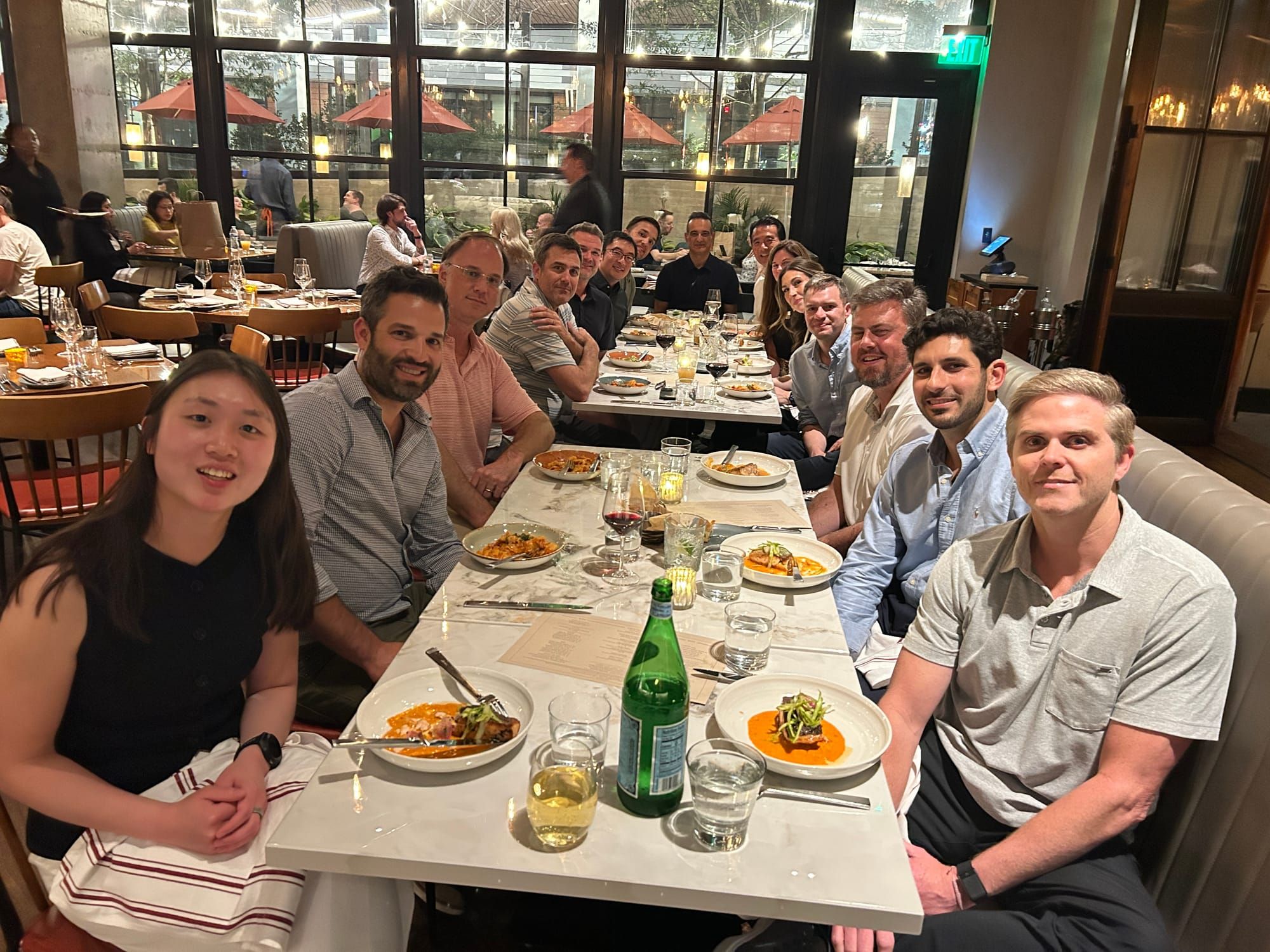
Big thanks to everyone who joined the Innovators Roundtable Dinner in Charlotte. It was a great mix of homebuilders, construction tech folks, and local GEMs from the residential side. We'll be back again next year, for another edition of the Housing Innovation Summit in Charlotte.
Are you planning to be in DC for the Realtor Legislative Meetings? If so, we'd love to see you at the lunch on 5/15 — big thanks to Jonathan Lawless for running the show. We also dropped an Innovator's Roundtable Dinner on the calendar for 6/23 in New York, hosted by Pierre Calzadilla. Grab a seat now before it fills up.
And don't miss Joe Schneider's reflections from a week on the Camino trail (included below)...
— Jesse Wright
EVENTS
NEW MEMBERS
ACTIVELY FUNDRAISING
- The America Housing Corporation - $50M Series A
- LotRoll - $3M Seed
- Zavvie - 10% Mezzanine Debt
- Quiet Cove - $750k Seed
- See more deals.
PS: The summaries and decks are only available to VCs and angel investors. Interested in accessing them? Please email us a summary of your investment activity at community@geekestate.com
MEMBER NEWS
- Revive upgraded its platform to bring together valuation intelligence, local market insights, home condition analysis, homeowner financial modeling and investment scenarios. — Dalip Jaggi
- Google home search is back with MLS data, eXp listings — Seth Siegler
- RentSpree Launches Nurture with Four More MLSs - Michael Lucarelli
- Clear Capital acquires AI-powered computer vision real estate leader, Restb.ai - Kenon Chen
- RPR® and Broker Public Portal Collaborate to Bring RVM® Valuations to Participating Cribio Markets -- Dan Troup
- Introducing Hint Home Management with Martha Stewart -— Andrew Serafin
- Offr and Salesforce have joined to offer a white-labelled Client Portal + CRM, purpose-built for real estate, across every sector, geography and currency. Commercial, Residential, PRS, BTR. -— Robert Hoban
- MoxiWorks Connects Marketing, Follow-Up, and Execution with New RISE Release. — Krista Hannahs
As always, links surrounded by the ❇️ indicate exclusive GEM content. If you would like to have access to all links or attend our curated gatherings, please consider GEM membership.
TRANSMISSION RECAP
This week, we dropped the PropTech Earnings Radar for Q1 2026. Prior, Drew ❇️compared the Camino journey to the homeownership journey❇️.
BIZ INTEL
PROPTECH EARNINGS RADAR - Q1 2026
Read full summaries for all ten companies in Part I. Read the full summary and see the table view in Part II.
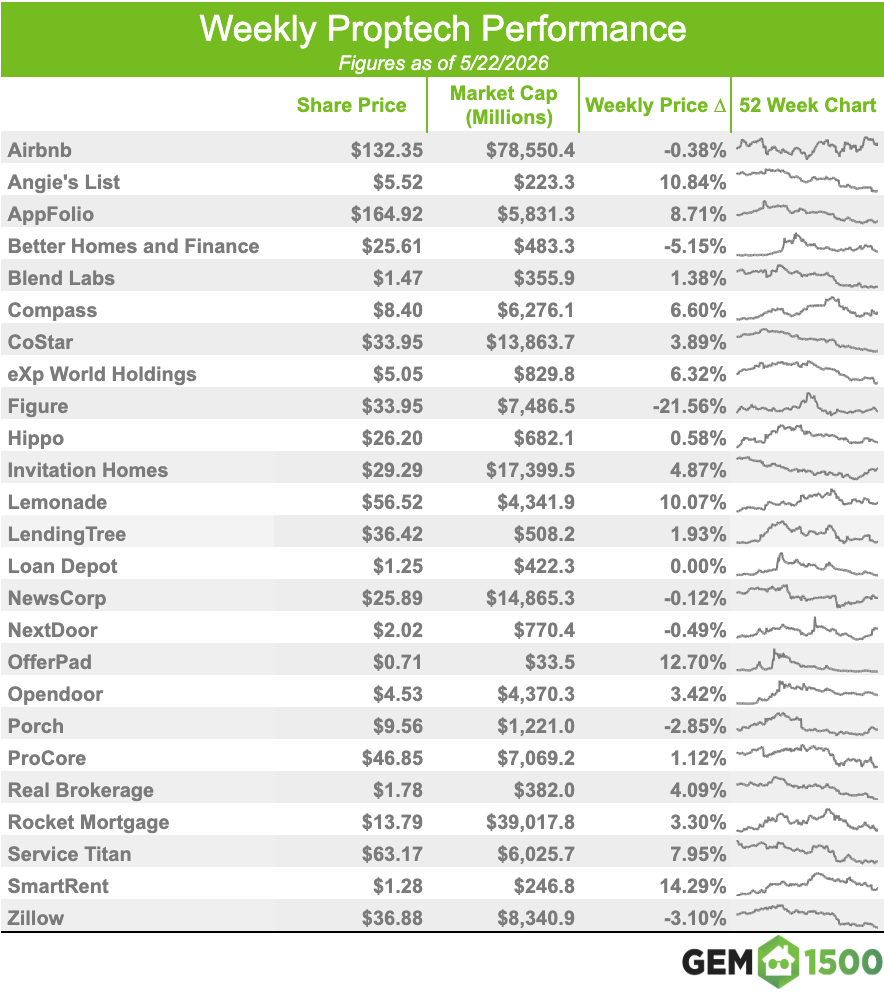
PROPTECH INDEX WEEKLY - AS OF 5/22/2026
Consisting of 25 stocks, the GEM Proptech Index had a combined market cap of $219.597B, an increase of 0.89% from the previous week.
OUT OF THE BOX
LESSONS AND REFLECTIONS FROM THE CAMINO PORTUGUES
By: Joe Schneider
When people ask about the Camino de Santiago, they usually want a simple answer. They want to know whether it was spiritual, transformative, difficult, peaceful, or life-changing. They want the experience condensed into something neat and something that fits into a quick conversation. That was me at least, before embarking on this journey.
The Camino resists simplification because it is all of those things at once. Some moments felt deeply reflective while others felt brutally physical. Some stretches of the trail were filled with laughter and ridiculous conversations. The kind of strange childlike joy that only seems to emerge when adults are removed from their routines long enough to stop performing competence for each other.
Walking the Camino Portugués with Drew Meyers as part of the GEM trip ended up being one of the most meaningful experiences of my life. It didn’t deliver a dramatic revelation in the way that I had romanticized before I left, but it stripped away enough noise for a few quieter truths to become impossible to ignore.
Before anything else, I left the trip feeling overwhelmingly grateful to my wife and daughter for giving me the space to go do something this selfish and personal. Being away from home for that long is not nothing, especially when you have a young family and responsibilities waiting for you on the other side of the world. My wife, more than anyone, knew the real reason I needed this trip, even if I probably struggled to articulate it clearly before I left.
I needed a reset.
Over the last several years, somewhere between work, responsibility, anxiety, constant connectivity, and the pace of modern professional life, I had gradually become very bad at being present. Even during moments that should have had my full attention, part of my brain was always somewhere else. Checking emails or refreshing Slack I was looking for updates. Thinking about problems that either did not exist yet or were not nearly as urgent as I had convinced myself they were.
The embarrassing truth is that most of the emergencies I carried around in my head were not emergencies at all. They were mostly projections and hypotheticals, and self-imposed pressure that I was putting on myself.
The Camino has a way of confronting that mentality almost immediately.
When your daily objective becomes walking fifteen to twenty miles through Northern Spain in the rain while managing tendinitis, shin pain, exhaustion, and wet socks, your priorities simplify very quickly. Your world shrinks down to extremely basic things. Finding coffee. Drying your clothes. Reaching the next town. Managing pain well enough to keep moving. Suddenly, the impulse to check your phone every two minutes feels almost absurd. Not because your responsibilities disappear, but because you slowly realize how little of the world actually depends on your constant attention.
The first couple days, I still felt the subconscious urge to reach for my phone. The curiosity about emails and the sense that I should probably be checking something. But somewhere between the eucalyptus forests, the rainstorms, the flow of the mountain creeks, and the repetitive rhythm of walking, that instinct began to loosen its grip.
The world kept moving without me.
Nothing collapsed. Nobody desperately needed my immediate reaction to anything.
That realization was both humbling and oddly freeing. I think many professionals quietly struggle with this more than they admit. We convince ourselves that our constant engagement is necessary when in reality, it often becomes a form of anxiety management disguised as productivity. The Camino interrupted that cycle by replacing artificial urgency with physical immediacy. It is difficult to obsess over inboxes while limping through a rainstorm trying not to slide down a muddy hill.
Physically, the Camino was also something I deeply needed. Physical exertion is something that modern professional life rarely provides anymore. I spend my days mentally exhausted but physically underchallenged. The body was built to struggle periodically, and somewhere along the way, many of us lost that relationship entirely.
The walk itself was grueling at times completing nearly one hundred miles over six days through constant elevation changes, heavy rain, slick stone paths, and enough accumulated soreness to make getting out of bed feel like a strategic operation by the middle of the week. My achilles started protesting early and then my shin pain followed chimed in. There were stretches where every step required negotiation with my own body.
And yet, buried underneath all of it was something deeply satisfying.
There was reassurance in discovering that I was still capable of hard things physically. Somewhere in my head, I still imagine myself as a far better athlete than reality probably supports at this point in life, but the Camino at least validated that the competitive and resilient part of me is still very much alive. Maybe not in the same form it existed twenty years ago, but present nonetheless.
What surprised me most, however, was not the physical challenge itself. It was how quickly the trail became an analogy for life in general.
The Camino is remarkably honest in that way.
Some days are effortless. The weather is perfect. Your body feels strong. The conversations flow naturally. The scenery is breathtaking. You laugh constantly and lose track of the miles because you are fully immersed in the experience. Those are the days when walking feels almost meditative, where you understand exactly why people romanticize the Camino so heavily.
Other days feel endless. Rain comes sideways for hours, and pain narrows your perspective until your world shrinks down to the next step and the one after it. The scenery stops registering because your body is demanding too much attention. You become tired mentally as much as physically, and the same trail that felt beautiful yesterday suddenly feels indifferent and unforgiving.
And then, inevitably, the difficult day passes.
That may sound obvious, but there is something profoundly different about physically living through that cycle repeatedly over the course of a week. One morning you wake up convinced the entire experience has become a grind. Twenty-four hours later the sun comes out, your legs loosen up, the conversation returns, and suddenly the Camino feels beautiful again. The emotional shift can happen almost instantly.
At the same time, it is important to keep the experience in perspective. The discomfort of the Camino is real, but it is also chosen. Every sore muscle, blister, and exhausted morning exists within the safety of knowing you volunteered for it and can step away from it if necessary. That reality separates this kind of suffering from the far heavier burdens many people carry without choice, escape, or applause.
Maybe that perspective is part of what gives the Camino its value. It offers a controlled encounter with discomfort. A temporary stripping away of convenience and certainty. Just enough hardship to remind you how quickly the mind can swing between despair and gratitude, and how resilient the human spirit can be when the stakes are relatively small.
After a rainy day, the sun finally broke through as we walked through the forests outside Pontevedra. The same trail that had felt punishing the previous day suddenly looked cinematic. The trees glowed differently, the air smelled richer and everyone’s (mine) mood improved immediately and significantly. The previous day’s suffering had not disappeared from memory, but it had already begun losing its emotional grip.
That basic understanding/re-acknowledgment has stayed with me after the walk ended because, looking back, the pattern has existed throughout my life as well.
The hardest periods of my life always felt permanent while I was inside them. Stressful seasons at work. Personal struggles. Loss. Anxiety. Uncertainty. At the time, those moments consumed perspective entirely. But eventually, without fail, life expanded again. New memories arrived. New joy replaced old pain. Things that once felt unbearable gradually became stories, lessons, or distant emotional landmarks softened by time.
The Camino compressed that emotional rhythm into six days.
There were moments on the trail when I genuinely questioned why anyone would voluntarily do this. Particularly during the stretches where pain became constant. Yet those same difficult days somehow became inseparable from the experience itself. Without them, the beautiful moments would not have carried the same emotional weight. A cold beer after nine wet miles tastes different than a cold beer on a normal Tuesday afternoon. Sunshine after days of rain feels exhilarating in a way ordinary sunshine rarely does.
The Camino recalibrates your appreciation for small comforts because discomfort is no longer theoretical. It becomes immediate and physical.
One of the most meaningful parts of the trip was also the conversations. There is something about walking for hours beside another person that strips away performative conversation. Without phones, distractions, schedules, or social expectations constantly interrupting attention, discussions naturally drift deeper. Some conversations were thoughtful and reflective. Others were unbelievably stupid in the best possible way. We spent portions of the trail discussing life, family, work, aging, ambition, and fear. Other portions were spent debating whether our walking sticks were legitimate hiking equipment or improvised medieval weapons being irresponsibly entrusted to two men mentally operating somewhere around the age of twelve.
Oddly enough, both kinds of conversation mattered equally.
By the time we finally approached Santiago de Compostela, the Camino had stopped feeling like a challenge to conquer and started feeling like a rhythm I did not necessarily want to leave. About four miles outside the city, we caught our first glimpse of the cathedral in the distance. Seeing it produced an immediate surge of excitement because, after days of walking toward an abstract endpoint, the finish line suddenly became real and visible.
Of course, the Camino had one final lesson left.
The cathedral looked close, but the trail continued winding endlessly through hills and neighborhoods, forcing us to earn every final mile. We climbed, descended, climbed again, and circled through the outskirts of Santiago while the cathedral seemed to remain suspended in roughly the same place the entire time. It felt symbolic in a way that only became obvious later. In life, meaningful destinations almost always appear closer than they truly are. Progress rarely moves in straight lines. You see glimpses of where you are headed long before you actually arrive there.
Eventually, we stepped into the Plaza del Obradoiro and stood in front of the cathedral after nearly one hundred miles of walking.
Rain. Mud. Pain. Eucalyptus forests. Mountain creeks. Deep conversations. Ridiculous conversations. Bikers being hesitant to “go for it.” Tendinitis. Laughter. All of it somehow leading to that square.
What surprised me most was that the feeling was not triumph exactly. It was quieter than that. The overwhelming emotion was not pride as much as gratitude.
Gratitude for the experience itself. Gratitude for my family. Gratitude for the reminder that difficult moments pass. Gratitude for the realization that presence is a skill that requires active effort, not something that simply happens automatically.
The Camino reminded me that life is rarely defined by a single moment. Most of life occurs in repetition. Waking up and continuing forward while managing discomfort and finding joy where you can. Trusting that difficult stretches eventually give way to easier ones.
That may not sound profound or even original, but I increasingly think it is one of the most important truths there is, and it’s maddeningly simple.
Bad days are rarely permanent. Good days are rarely permanent either. Both pass. The goal is not to eliminate hardship or chase happiness, but to stay present enough to move through both without getting stuck in either one.
Somewhere between Tui and Santiago, over nearly 100 miles of walking, that stopped being a theory and became experience.
REAL ESTATE
SCORCHING RESIDENTIAL'S EARTH
By: Drew Meyers
There's been no shortage of developments in residential the last few weeks…