
AI's Missing Real Estate Revolution (Transmission #362)


Zillow’s stock price—arguably the clearest public-market proxy for residential real estate portal dominance—has remained virtually flat over the past decade. After a brief surge during the zero-interest-rate era, valuation ($6.7B) has since retreated back to the company’s valuation post Trulia merger (about $5.3B, plus Trulia’s $3.5B valuation). Meanwhile, AI is reshaping virtually every adjacent software category.
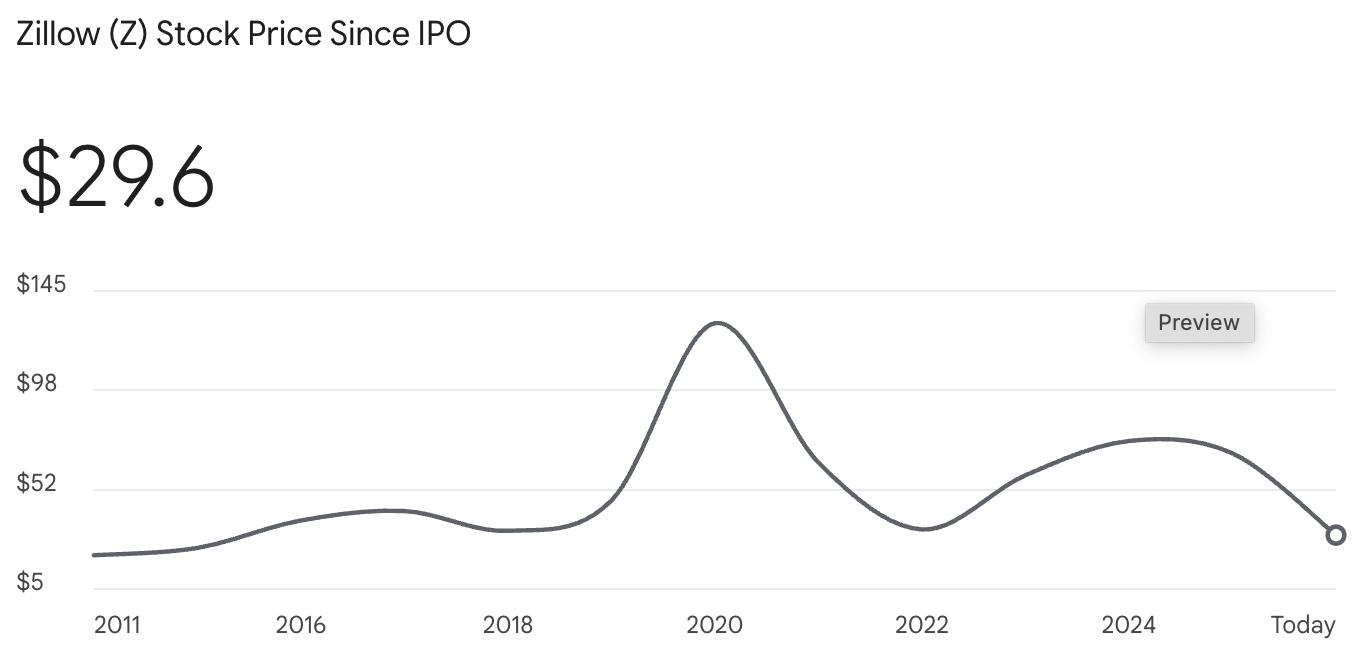
I’ve spent the better part of the past few months trying to understand that disconnect. Zillow is the most visible example, but the question extends to the entire residential real estate portal business. Where is the transformational AI opportunity that will fundamentally change the economics of these companies?
AI is consuming the technology stack at an unprecedented cadence. Foundational LLM capabilities are expanding rapidly, and private market valuations surrounding upcoming public offerings (like Anthropic) verge on the absurd (let’s call a spade a spade, it’s bonkers).
Yet, under current market conditions, Compass—a legacy brokerage model under the hood that dresses itself up well as a tech platform—commands roughly the exact same market capitalization as Zillow. That's a strange comparison in an era when AI is supposedly transforming the technology layer of every industry.
The narrative driving institutional public markets is straightforward: