
GEM Content Examples & Approach

Content offerings in GEM include a curated selection of industry developments, outside-the-box thinking, thought-provoking long-form essays, and a quarterly earnings radar to keep tabs on late stage players operating in the public markets.
Our analysis is written for the smartest person that exists. Page views, clicks, and attention is not our jam. If we don't have something worthwhile to say, we just don't publish – compared to media entities that publish no matter what because more content means more page views to put ads on.
Content Examples
Weekly Transmission: Thought-provoking long-form articles covering a wide spectrum of topics, from innovative shipping container co-living spaces to the battle for listing acquisition in the first iBuyer world war to the implications of floating cities seen from beaches far and wide.
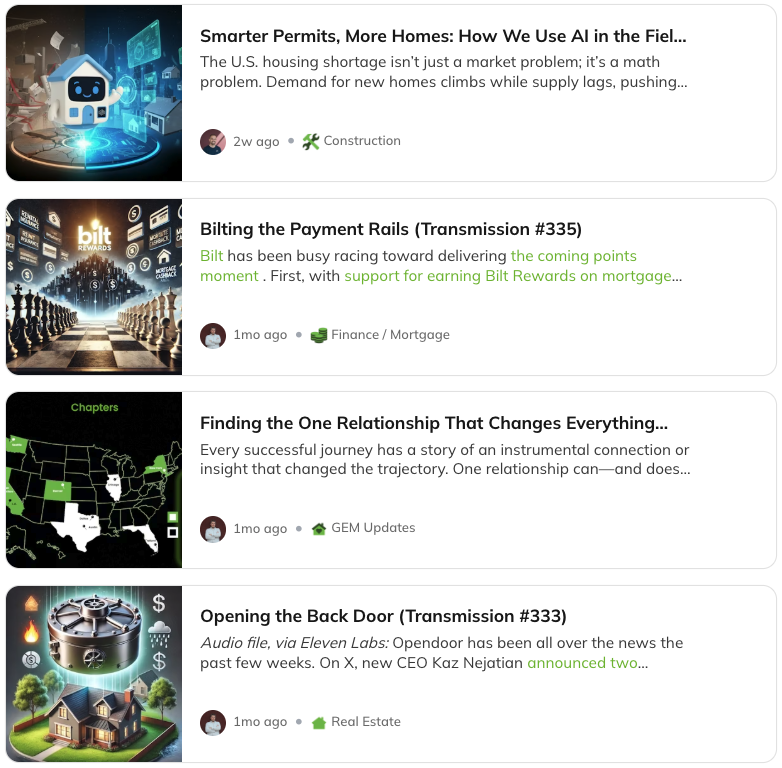
Examples: Wellness: A New Paradigm for How We Build (#326) // Riding the 100% Adoption Bicycle (#309) // Organizing the Coming Skyward Chaos (#307) // Searching What Could Be, Rather than What Is (#287) // Banking Real Estate in the Clouds (#242)
Weekly Radar: A curated digest of real estate, startups, and built world links & analysis blended with out-of-the-box ideas.
Examples: How To Be Hunted By VCs, Turning The Paper Napkin Into A 747... Enter Advisory Circles, Proptech Index Down 2.91% (#365) // 52,000 Residences Strong, At the Buyer Demand Table, Regulation For Landlords = Adoption For Rental Tech, Proptech Index Increased 4.54% (354)
Biz Intel: Includes ecosystem intelligence articles to better understand sector of proptech activity, Proptech Earnings Radars (quarterly), and Proptech Index tracking the public markets (weekly).
Examples: Proptech Earnings Radar Q3 2025 (Part 1 and Part 2)
Hear Ye, Hear Ye
GEM has always been all about culling signal from noise. Across both content and connections.
A modernized riff of mine from 2013:
Remember the age old saying…”Hear Ye, Hear Ye, Read All About It“?
It’s the phrase from the late 1800’s to the mid 1900’s that immediately brings to mind a teenage paperboy standing on the corner trying to get your attention (and your money) to read the latest breaking headlines in the day’s newspaper—then the only source of news available.
Fast forward to today. It’s not just the paperboy standing on the corner trying to get your attention.
It’s the whole damn crowd.
Every person you walk by on Twitter, Instagram, Linkedin, or Facebook (or the thousands of other social sites in existence)—is trying to get your attention.
“Extra! Extra! Read all about it.”
You know what?
No one is listening. No one is reading. And, certainly, no one is discussing.
The attention economy has no shortage of writings on the topic. That’s what we’re left with when the whole entire internet is given the opportunity to be a publisher. Sure, society ends up with some great stories from underground sources that never had a voice before and that otherwise wouldn’t have seen the light of day—but we end up with a whole lot of crap to wade through as well. Too many people want to run around firing off 140 character Tweets without giving them a second thought. What people don’t seem to want to do is actually think, and put time into formulating real opinions and solutions.
We’re all busy. I get it. But—are we too busy to think?
The sentiment in that article is a big reason GEM exists today.
The bet was that subscriptions would alleviate the trolls and increase attention. That a dedicated focus on operators would foster meaty discussions that move this industry, and world, forward. That strategic analysis hitting on real problems would fill a need in proptech for intellectuals. That out-of-the-box thinking packaged in the right way spurs innovative ideas. That a distributed revenue model could avoid the too-often-followed path of writing for advertisers (aka page views and clicks). And, last but not least, there was an unserved market for small curated gatherings of C-level execs with a mutual passion for homes, apartments, offices, hotels, and the associated amenities that impact their respective values.