Organizing the Coming Skyward Chaos (Transmission #307)

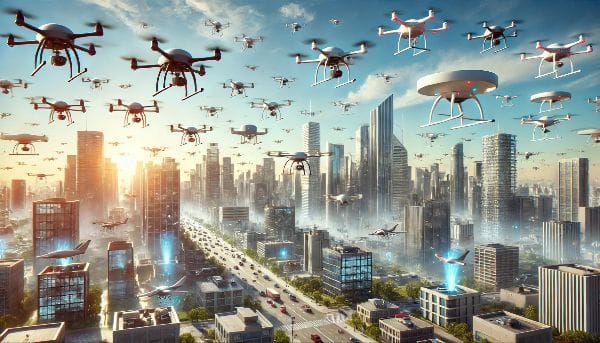
The future is one with many, many machines and devices navigating the airspace above us every minute of every day.
With a range of 60 miles, Eva Air is building a full scale prototype of its eVOTL for passengers. Archer’s Midnight electric air taxis are coming. Draganfly is bringing an array of machines—like the Apex and Heavy Lift Drone—to sectors such as public health, oil & gas, and defense & government.
The FAA has registered 791,597 drones as of October 2024. The trend line will no doubt skyrocket up and to the right.
And one day, instead of a way to send 140 characters into the abyss, we’ll finally get those long-awaited flying cars we’ve all been promised.
All of these new machines will be regulated, of course, not unlike how the commercial aviation industry has been for decades. With small devices whizzing around, landing and taking off every few minutes, the operational and technical complexity is exponentially more challenging than whisking 747’s into the air from centralized airport hubs.
Prime Air received FAA approval earlier this year, with College Station (TX) and Phoenix as early test markets. Unlike Amazon, most companies don’t have trillion dollar market caps with nearly unlimited resources for R&D and regulatory work.
There is a category king opportunity to emerge as the air traffic controller for the entire ecosystem.
AN AERIAL FUTURE
HoverSafe, with its SaaS solution that helps cities, counties, states, and government entities ”prepare and implement low-altitude ecosystems,” calls the opportunity the New Aerial Economy (NAE). The public sector has big needs to fill around safety, code compliance, support, and monitoring to serve the infrastructure that will eventually be an everyday reality.
Skyway, an urban development and transportation leader, is already building vertiports and a “secure automated airspace authorization cloud service for the aviation industry.” Since “regulations mandate that all drones registered to fly in the United States airspace be equipped with a ‘digital license plate’," those without a Remote ID Broadcast Module will require retrofitting, according to Skyway.
Its services break down into four primary areas: air traffic management, vertiport management systems, sUAS traffic management, and vertiport planning and development.
With Skyway’s Air Traffic Navigators, urban developers, contractors, environmental consultants, and urban mobility architects gain access to the deployment ecosystem and startup community being built.
Skyportz is another entrant playing in the infrastructure for aerial mobility sandbox, while aviation ground service companies such as Moonware, already a partner of Skyway’s, will deliver “fully connected & intelligent airfields that handle aircraft autonomously from touchdown to takeoff, enabling the next generation of air transportation.” The efficiency of getting machines into the air will be like nothing we’ve ever seen.
All of this is great. But how will the ability to deploy autonomous drones into a crowded sky from airports, sports venues, and distribution centers impact real estate assets?
LAUNCH & LANDING PADS GALORE
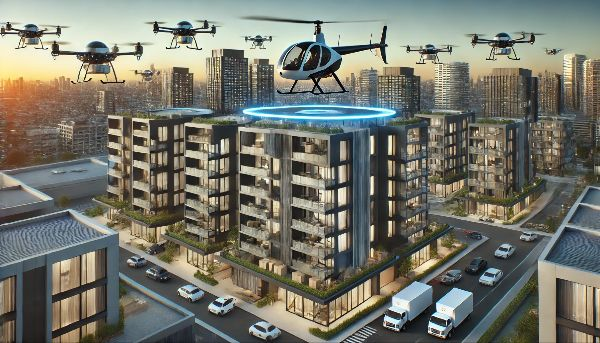
Every building is now prime space for a dual launch and landing pad. Many large multifamily and office buildings will contain a heliport able to accept these new mobility solutions, both package deliveries and arrivals of humans using the next generation of rideshare (or, “airshare”) services.
Arrive mailboxes integrated in the next generation of homes will become commonplace. As will neighborhood drop-off locations for larger machines transporting people to and from urban centers.
All of these locations must connect to a centralized, cloud-based traffic management system—this is the huge moat that Skyway is clearly going after. Drone mobility flights will require fees to use the infrastructure and marketplace layers in just the same wayOTAs collect on tickets sold and airport terminals charge fees for landing, ticket counter and gate usage, and baggage handling. Skyway will be in a prime position to collect and distribute said fees, and tax for the convenience.
One question is whether a single provider will control everything, or whether multiple companies will monitor those machines roaming the skies. Even if a single company emerges dominant in traffic management, ancillary services will crop up in domestic and national markets necessitating solutions ranging from air regulatory compliance as a service, security and monitoring systems, charging and energy storage services, and last-mile logistics solutions for transitioning packages and passengers.
As we all look skyward into the future, smart proptech founders will create on-the-ground solutions that will provide the critical technology and infrastructure needed for a smooth transition to busier skies. Just as companies like Blueprint Power help building owners monetize their energy consumption, acting as a power plant, a new breed of technology solutions will help commercial and residential building owners play a critical role in the New Aerial Economy about to be unleashed.