
Looking Back on 2025: Swings that Generated Contact, and Whiffed (Transmission #339)

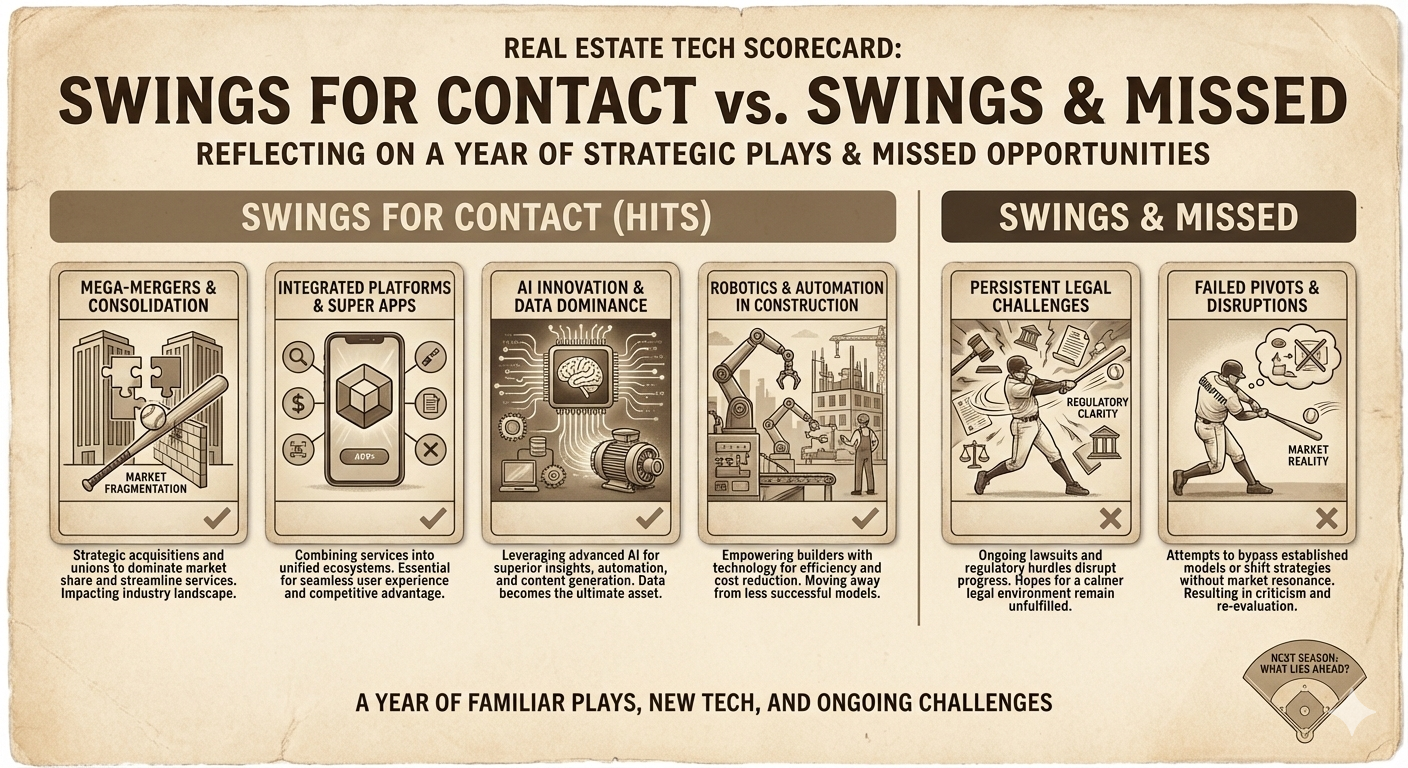
I'm not sure how to reflect on 2025, other than to say we've seen this before: lawsuits, discount brokerage plays, rough fundraising waters, M&A, and AI upheaval. David Bluhm's 2025 "more of the same" prediction was spot on.
Here’s a snapshot of the most notable industry dynamics that played out:
Anywhere-Compass: There is no question the Compass merger with Anywhere was the largest industry development of the year, at least on the residential side. ❇️The bombshell of bombshells❇️ marks the beginning of domination of big brokerage shops and private listings chaos (and portal turmoil as a byproduct). Short of regulatory approval stopping the train from reaching its final destination, the impact of this deal will reach every corner of the industry.
Redfin-Rocket: ❇️ Rocket's array of financing tech and expertise plus Redfin's 2,200 agents leapfrogged Zillow in the quest to deliver a "housing super app."❇️ Can independent brokers across the country survive in the future without being attached at the hip to a mortgage/title/closing engine? Not likely.
Lawsuits Galore: From the Compass-Zillow suit to the Beagle Labs-Appfolio showdown to FTC versus Zillow and Redfin to DOJ versus RealPage, 2025 was the year of proptech legal wars. If there’s one thing I hope for 2026, it’s that companies decide enough is enough with the legal skirmishes already. If we're talking lawsuits in 2026 reflections, I won't be a happy camper. That said, something tells me, I will be an unhappy camper come next January…
Rise of Gemini: The launch of Gemini 3 was a turning point in the AI war. The data advantage Google has is beyond immense. Another example of the reality that being first (at anything) doesn't guarantee victory. One small data point is that GEM has since switched all our image generation from OpenAI's DALL-E to Gemini's Nano Banana Pro.
Opendoor Reboot: It wouldn't be right to exclude ❇️ the Opendoor upheaval❇️ as one of the biggest stories of 2025. In fact, if I open X, it's literally impossible to avoid—as I'm flooded with Opendoor commentary every time I open my feed. The company is ❇️ going back to its origins of bypassing the agent in the transaction❇️ . And ❇️ my wager is on home management being part of the play❇️ .
Robotics as a Service in Construction: The end-to-end home/building manufacturer playbook ❇️ Katerra❇️ and ❇️ Veev❇️ tried didn't work. It’s now a game of empower the local builders and AEC firms with advanced robotics to drive efficiency and cost reductions, with BotBuilt and Auar as shining examples.
And, with that, time to oil the machines and get to it…

Curious? Additional examples.
Proptech's Leader has Been Crashing Our Couch the Whole Time // Stock in Down Payments // Banking Real Estate in the Clouds
As always, links surrounded by the ❇️ emoji indicate exclusive GEM Diamond content. If you would like to have access to all links, please consider GEM membership.
REFLECTIONS ON 2025
How did we fare? Let’s reflect on several of the predictions and trends published a year ago.
**Reflections are written by those who wrote the original entry a year ago, unless a DM is in front of them. In which case, they are my thoughts.
PROPTECH TRENDS
REAL ESTATE
AI-FIRST SEARCH RESOURCES BECOME MAINSTREAM
Anthemos Georgiades, Co-founder, Zumper
Renters will have access to a significantly wider array of AI-first resources designed to enhance the rental search experience. Nearly half of all the renters Zumper surveyed would consider using AI to find a rental home in the future, and a small % of renters already reported using an AI platform to find a rental home in 2024. Specifically, AI-powered virtual assistants, capable of contacting properties and even scheduling tours, will see significantly broader adoption in 2025. Expect to see the same behaviors in the parallel vertical of For Sale search, too.
Verdict: Loss
DM Reflection: While AI-first resources are more common than a year ago, I wouldn't consider a "mainstream" adoption level having been reached yet.
CONSUMER FIRST THINKING
Errol Samuelson, Chief Industry Development Officer, Zillow
My hope for 2025 (and beyond) is to see the industry choose long-term prioritization of the consumer over the lure of short-term business gains. Fads come and go–but with the mindset that the consumer always wins, companies stand to benefit by putting the consumer first.
Verdict: Loss
DM Reflection: To me, though Zillow is still putting consumers first, the consumer isn't ruling the day across the industry. If they were, the brokers would be off working on serving them day-in, day-out rather than battling CCP out in court.
CCP ADJUSTMENT, BUT REMAINS ON TABLE
Eileen Romito, Head of Partner Development & Ops, Zenlist-Realtor.com
Clear cooperation was hotly debated this year, but no decision took place. Given NAR has been in the line of sight for the DOJ, news media, and even large brokerages this past year, the debate is sure to continue. But, like Congress, wrangling the agreement of thousands of stakeholders, many with diametrically opposing views, means that changes are more likely to be incremental rather than drastic. The overall sentiment of MLS executives at the 2024 Council of Multiple Listing Services event was obvious: Clear Cooperation Policy is highly unlikely to be removed from the NAR MLS Policy Handbook. But,I do think it will probably undergo some adjustments—either to the length of time before which the policy applies, or by more narrowly defining what constitutes public marketing.
Verdict: Win
Reflection: Well, that escalated quickly. Let’s start with Zillow jumping into the battle to effectively protect CCP with its Listing Access Standards, then Howard Hanna authoring a letter to NAR and major MLSs proclaiming itself no longer bound to CCP, followed by Compass hitting back at Zillow with an antitrust suit in an effort to protect Private Exclusive listings. In 2025, the power dynamics shifted rapidly. As these power shifts were unfolding, NAR issued a new policy allowing for delayed marketing of listings (DMEL), acknowledging that saving CCP would require removing the most uncompromising constraints that sparked the rebellion. So, while the CCP was preserved in name, the new DMEL policy effectively moved the goalposts of CCP from “publicly visible” to “visible by agents.”
THE HOMEBUYING REVOLUTION: AI IS TRANSFORMING THE MARKET
Vin Vomero, Co-founder, FoxyAI
The homebuying process, traditionally characterized by uncertainty and stress, is being revolutionized by artificial intelligence. AI is transforming how buyers and sellers navigate the real estate market—offering greater efficiency, deeper data insights, and a tailored experience. In 2025, we expect to see a further automation of complex tasks, reducing guesswork, and providing hyper-personalized recommendations; AI will continue to address some of the biggest challenges in homebuying, from finding homes with desired features to property valuations.
AI-powered software can analyze a buyer’s preferences—location, budget, desired amenities, and even lifestyle needs—to offer tailored suggestions. This level of precision will continue to be refined and eliminate time-consuming searches, and will ensure that buyers are presented with homes that match their personal criteria. For example, a buyer will be able to quickly search for and find a property that has personally relevant criteria, e.g., a garden with a marble fountain that depicts a Roman goddess. As consumers increasingly expect this level of customization, real estate professionals leveraging AI gain a competitive edge—offering a more intuitive and satisfying homebuying process. In addition, AI can analyze real estate imagery to provide accurate property valuations, allowing buyers to make more informed decisions including condition- and quality-enhanced AVM. Beyond valuations, AI helps optimize homes for market readiness by offering renovation and investment recommendations, like suggesting a specific kitchen remodel for a desired condition and quality level including providing an inventory of the required materials with part numbers or landscaping update that adheres to a desired budget. Coupled with innovations like virtual tours, these advancements will help create a more personalized and data-driven homebuying process across the entire value-chain—providing buyers and sellers with all the information they need to satisfy their personal criteria, however nuanced or unique.
Verdict: Win
Reflection: While a strong win, there was a touch of "draw" on the edges. Overall, the general trajectory and direction of my vision were accurate, with most elements materializing and others actively progressing.
AI has continued to reshape the homebuying process by streamlining operations and enhancing personalization. AI-driven property recommendations based on buyer preferences have become more mainstream. Both proptech startups and major listing platforms increasingly offer tools that use NLP, visual search, and lifestyle-driven filters. AI-generated virtual tours, floor plans, photo-based condition assessments, and AVMs that incorporate quality and condition indicators have also seen increased adoption.
However, some of the more granular capabilities, like searching for ultra-specific features (e.g., “a garden with a marble fountain of a Roman goddess”) or fully automated renovation planning with part inventories, aren’t yet mainstream. These innovations are emerging, but not widely deployed.
MASS CONSOLIDATION IN BROKERAGE
Robert Hahn, Founder, Notorious ROB
[Adapted from Seven Predictions for 2025.]
Combining the #1 and #8 brokerages by volume and #4 and #11 by transaction sides, one of the biggest news items of 2024 was Compass acquiring @Properties, which also owns the Christie’s International Real Estate brand. Christie's International Real Estate has global reach with a network of 100+ independently owned domestic and international Affiliates across 50 countries and territories. A merger that big is important on its own, but what makes it even more significant is the fact that Robert Reffkin of Compass has emerged as the biggest critic and opponent of Clear Cooperation Policy and touts its explicit 3-phased marketing strategy.
Those of us in the industry already know that MRED — the MLS in the Chicagoland area — already allows for Private Listings. In theory, MRED’s Private Listings complies with CCP, since it requires entry. Well, Compass and @Properties were #1 and #2 in Chicago, and the combined entity has almost three times the market share of the #3 brokerage, Coldwell Banker Realty the company-owned brokerage of Anywhere. Baird & Warner and Berkshire Hathaway HomeServices Chicago round out the top five. The Compass + @properties entity is going to have a lot of inventory in the already-permitted Private Listings program. In a slowing market, the bigger brokerages have an advantage in recruiting agents–and private listings is a superpower that makes it nearly impossible for small brokerages and franchisors to compete against big brokerages. We know that Compass + @Properties will be a nearly insurmountable presence in Chicago (15-20%). The small brokerages will suffer.
But what do the other big brokerages do? Sit back and allow Compass + @Properties to plunder their agents using “internal inventory” and market share to do so? Of course not.
If you are Coldwell Banker Realty (#3) or Berkshire Hathaway HomeServices Chicago (#5), you have got to be looking really, really hard at Baird & Warner (#4) as well as Dream Town Real Estate (#8) and others in the top 15, no? If you are eXp Realty (#10) and you want to remain competitive in recruiting in Chicago, don’t you also have to do the same? And the thing that those three have that most of the others in the Top 15 do not have is money. Lots and lots of money and access to capital, as publicly traded companies. Hell, HomeServices can just go ask Uncle Buffett for cash to do acquisitions.
I think they go on an acquisition spree to defend themselves against the monster that is Compass. They have to. Even if they are the biggest fans of CCP — like eXp Realty is — they have to get far more market share in major markets across the U.S. if they are to compete with Compass for producing agents.
Now do that across all of the NFL cities in the U.S. Not just with the Big Four public companies of Compass, Anywhere, eXp and HomeServices. Add in some of the other big players: Real, United Real Estate, HomeSmart, Howard Hanna. They all have to get bigger, or eventually get swallowed up by even bigger companies… after losing a ton of their productive agents to them.
So they will get bigger. A wave of brokerage consolidation will begin in 2025. I expect the top ten brokerages not named Redfin to be saying, “I’d leave you alone, darling, if I could. But I want you bad and that ain’t good.”
Verdict: Draw
Reflection: I mean… on the one hand, the top 10 brokerages did not go on a consolidation spree with one major exception. On the other hand, that major exception was ❇️a total industry-changing deal where the #1 brokerage (Compass) acquired the #3 brokerage (Anywhere)❇️ and created the Clear Number One With a Bullet that will change everything. So I’d call that a draw.
Upon reflection, I guess what 2025 showed was how broke brokerages actually are. Especially after paying out settlements in Sitzer and dealing with a terrible housing market, it appears none of them wanted to grow and expand. All of them likely were hunkering down to weather the storm. Except Compass, because Reffkin’s got brass cojones while everyone else was apparently playing “Protect what we got” games.
If they do the same hunkerin’ down in 2026, then they will be acquired by someone bigger since it is now patently obvious that you either get big to compete with Compass 2.0 or you get bought by someone who wants to contend with Compass 2.0.
IMPROVEMENT OF AI HOME SEARCH IMPLEMENTATIONS
Drew Meyers, Founder, Geek Estate
Though the execution thus far is poor at best, AI-powered home search is here to stay. ListAssist has already partnered with Howard Hanna with arguably a better experience. That said, the portals are no doubt investing heavily into ensuring search queries by buyers result in relevant results. This is the year that the technology catches up to consumer expectations.
Verdict: Draw
Reflection: While improvements were undoubtedly made and ListAssist was acquired by Inside Real Estate (congrats Chris McGoldrick), I can't say the consumer search experience is visibly superior for. ❇️The ChatGPT-Zillow implementation is so, so slow❇️. ❇️As previously stated❇️, I still can't help but wonder whether the longstanding “I tell you what I want” and “you show me properties” is actually the end-all, be-all of AI in real estate search.
STARTUPS
TOO MUCH OF ‘MORE OF THE SAME”
David Bluhm, Partner, agnitio capital
Proptech Investment—both seed and growth—as well as both venture capital and M&A, have been challenging all through 2024. But that is not news to anyone. Never mind a very mild improvement during 4Q’24 in Proptech VC activity.
Restoration and growing value of unique datasets (see intro) are among the ripe areas of opportunity. Our 45-year-old housing stock, the growing inevitability and impact of widespread weather disasters along with a decided decline in handyman skills amongst next generation homeowners all point to a very large home restoration opportunity. These two areas of innovation will help lead the way back to a more healthy M&A market in 2025.
Data startups to watch grow in ‘25: Rental Beast, Homeowner.ai, RealReports
Restoration startups to watch grow in ‘25: Bosscat, RocketPlan, Clear Estimates
Verdict: Win, Draw and Win
Reflection: Espousing “more of the same” was certainly a safe prediction for 2025. It would be hard to argue against that sentiment accurately capturing the business climate we all worked to navigate over the last 12 months. GEM’s Proptech index tracking over the last 12 months, while reflecting many stocks with as much as 25-30% price swings during 2025, characterizes a housing economy that is merely an extension of 2024. Lay up Win.
Grading an equally safe prediction that home improvement will represent a strong area of consumer spend, start up activity and value creation is hard given the lack of even small proof points - let alone any high profile, publicly available transactions. Having clients in the space, I remain confident that 2025 fueled a lot of forward movement but none yet realized. Draw.
A larger scale turn of attention to the underlying data sets that power the RRE market warrants a win. It consumed nearly 100% of the industry’s strategic focus in 2025 - all thanks to the promise (and competitive necessity) of AI. The quality and overall impact of generative and Agentic AI innovations are based on the underlying data sets they leverage. This is true across the entire Proptech landscape. We are all now looking for defensible advantage through unique data. If you are not, you are effectively being obsoleted. Win.
LIVE OR DIE BY DISTRIBUTION
Nate Smoyer, Head of Marketing, Lula
Distribution will take the forefront as a focus for early-stage proptech companies. With the ever-rising costs of advertising networks, reduced organic reach across nearly all social media platforms, content production across-the-board ramping up in volume (both human and Ai-driven)—attention is as expensive and as difficult as it has ever been.
The reduced amounts of money available for funding only exacerbates this problem as many startups aren’t and won’t be getting the extra cash for brand awareness and promotional purposes. Distribution is King and will take the forefront whether you’re choosing to use partnerships, embedded modules, media and earned relationships or building our products that naturally generate referrals. Absolutely winning at distribution has always been an advantage, but in today’s market, it’s a requirement to stay afloat.
Verdict: Win
Reflection: Probably the biggest shakeup was search. The hot-debate now is, “Is top-of-funnel search dead?” I say no, it’s not dead, but it’s entirely different and most haven’t adjusted so it feels very much dead. With the increased use of AI overviews and contextual searches moving to LLMs, gone are the days of capturing lead lists writing posts “What is X” and “Definitive Guide to Doing Y.” Social advertising is being used as much, if not more than ever before for marketing distribution. Meta is looking at ~20% YoY ad revenue increase compared to 2024. In some ways, organic social still has its place and hasn’t totally fallen off. Did you notice this year seeing posts on LinkedIn 2-3 weeks old? If you did, that means your feed is looking for organic content to serve up. There’ll be no slowing to the changes in how brands must work to reach customers with their products online in 2026.
BUILT WORLD
GLOOMY DAYS FOR MULTIFAMILY OPERATORS
Brad Hargreaves, Founder, Thesis Driven
[Adapted from Six Themes We're Watching in 2025.]
For much of the past year, multifamily owners have dealt with sluggish rents driven by a record number of deliveries. As 2021’s hottest markets see declining rents, owners are eagerly awaiting new supply to peter out—something that should theoretically be on the horizon given 2022’s interest rate increases and rapid slowdown in construction lending.

Unfortunately, 2025 will not be that year.
While the coming year will see fewer deliveries (508,000, per Yardi Matrix) than 2024’s record (estimated 518,000), it’s still far above historical norms. The late 2010s, for instance, saw around 350,000 new units per year hit the market. And the current apartment surge is coming at a time when demographics are shifting against the multifamily sector: The age cohorts graduating from college over the next few years are somewhat smaller than those that preceded them.

And this isn’t even taking into account the demand shock that would come from the next administration’s plans to deport 10 to 15 million immigrants. Ignoring that, multifamily owners are in for a rough year. With it, we’re looking at a catastrophic year.
Verdict: Win
Reflection: Multifamily rents fell nationwide in 2025 as a combination of historically high deliveries and (likely) net negative immigration which saw operators get squeezed on both the supply and demand sides of the equation. In some Sun Belt markets in Florida and Texas, for instance, rents fell by more than 20%.
Unfortunately 2026 is unlikely to be much better, with immigration likely to remain sluggish and long-term demographic trends beginning to turn against multifamily.
STABILIZATION AND PROFESSIONALIZATION OF THE STR ASSET CLASS
Emir Dukic, Co-founder, Rabbu
The short-term rental (STR) market is set to stabilize in 2025, marking a turning point for the asset class. Before COVID, supply and demand grew steadily in balance. The pandemic disrupted this, with demand surging in the first two years of the pandemic and supply struggling to catch up.
Over the past two years, supply growth outpaced demand growth creating oversaturation in some markets and negatively impacting existing properties.
Now, supply and demand are finally growing in tandem, restoring pre-COVID market dynamics. This stability sets the stage for the professionalization of STRs, as operators refine their offerings, enhance guest experiences, and adopt technology to stay competitive.
2025 will be a pivotal year, shifting STRs from post-pandemic turbulence to a more mature and sustainable phase.
Verdict: Win
Reflection: 2025 did mark a clear turning point toward stabilization and professionalization in the STR asset class. Early in the year, Casago’s acquisition of Vacasa was a strong signal that STR management is shifting away from national, one-size-fits-all platforms toward local, market-specific operators. The return of 100% bonus depreciation reignited investor interest and capital deployment, while the collapse of Sonder reinforced that asset-light, liability-heavy models (similar to WeWork) don’t work at scale in this category. Importantly, guest demand for STRs continued to grow at double-digit rates, confirming that the consumer side of the market remains strong. Together, these dynamics validated the thesis that 2025 would be less about recovery and more about maturity, discipline, and sustainable growth.
CONSTRUCTION
MARKET VOLATILITY CATCHES UP TO INFRASTRUCTURE AND CONSTRUCTION INDUSTRIES
Stephen Del Percio, SVP & Deputy General Counsel, WSP USA
For the past few years I’ve made specific predictions about what might or might not happen in the civil engineering, infrastructure, and construction industries, from an AI takeover of the design process to micromobility M&A and public company mega-mergers. I’ve been mostly wrong, but as mentioned in my 2024 year-in-review, I still believe those macro trends are tailwinds which will shape the future of the AEC industry.
For that reason, my 2025 prediction is to expect the unexpected. Whether it’s M&A or a high-profile corporate implosion or another tectonic activity that shakes the fundamentals of the AEC industry, this is the year that the tranquil waters the industry has sailed through during the Biden administration will start to churn. Where things end up by January 2026 is anyone’s guess but I would be surprised - this time - if the status quo reigns in 2025.
Verdict: Draw
FINANCE
PRIVATIZATION OF FANNIE/FREDDIE
Heather Harmon
Look for the incoming administration to take steps towards privatizing Fannie Mae and Freddie Mac, meaning ending the conservatorship that has been in place since 2008. There’s a high likelihood that this will initially increase mortgage rates. Impacts to the consumer could be both positive and negative as initiatives that are locked up could get more products available, while stabilizing yet unfinished policy reforms could leave consumers with a less reliable process and/or higher costs in the meantime.
Joe Dahleen, Managing Director of Strategy and Sales, Silverwork Solutions
Since 2008, grappling with the government role in the mortgage marketplace has been divisive with politics, and the highest ever G Fees. Releasing the GSE’s from conservatorship in the area of DOGE will happen and it will open a level playing field for all sellers. With the conservative trifecta controlling three branches of government, we will finally see this happen.
The conservatives will also use this idea to lower interest rates even further. They will come out and say that restructuring empowers the agency to fix structural flaws of the GSE pre-crisis business model while supporting what works today in the secondary transactions.
Verdict: Loss
Heather Reflection: In reflection of my speculation that moves toward privatization could nudge rates higher and create a mix of new products plus new friction for consumers; 2025 delivered the debate and the volatility on both counts, even if the final GSE endgame stayed in ‘coming soon’ mode. While Trump and his team openly framed privatization as a core policy goal through 2025 and have floated timelines as aggressive as a large IPO by year‑end, those plans continue to be signals that the market has to navigate.
ENHANCED CONSUMER EXPERIENCES THROUGH INTEGRATED DIGITAL TECH IN RETAIL MORTGAGE
Joe Dahleen, Managing Director of Strategy and Sales, Silverwork Solutions
Having closely monitored and contributed to the evolution of retail mortgage processes, I’m convinced a significant shift towards a more immersive and efficient digital consumer journey is coming down the pike. As we stand on the threshold of 2025, expect to see an unprecedented level of integration between AI-driven platforms and traditional mortgage operations, with the key driver being the consumer's demand for faster, more transparent, and more personalized service. AI and machine learning will move from being supportive to central in driving operations, with persona-based bots becoming integral in every step of the mortgage process.
Moreover, the use of real-time data analytics will allow lenders to offer more customized loan products that meet individual borrower needs. Not only will this data-centric approach streamline the approval process, but also significantly reduce the time from application to closing. Further, the integration of blockchain technology will ensure that all transactions are secure and transparent, thereby increasing trust and reducing fraud. This will be complemented by advancements in mobile technology, providing consumers with the ability to manage their mortgage application and interact with service providers from anywhere, at any time.
Beyond the consumer experience enhancements, the integration of these technologies will increase operational efficiencies, reduce costs, and drive greater scalability in the retail mortgage sector. As a result, by 2025, the mortgage industry will be more adaptive, innovative, and consumer-centric than ever before.
Verdict: Win
Reflection: The core of this prediction landed well, with one important clarification around blockchain. Consumer expectations for speed, transparency, and personalization are now table stakes, and lenders that invested early in integrated digital workflows clearly pulled ahead. AI became operational, not aspirational, particularly through role-based automation that fit existing compliance and credit frameworks. Where blockchain did break through meaningfully was in home equity. Figure proved the model by powering private-label HELOC and second-lien origination at scale, unlocking trapped equity for borrowers sitting on sub-3% first mortgages. That surge in HELOC volume reshaped lender strategies and created real pressure on loan servicers, especially those focused on retention of first-lien assets. Mobile engagement, real-time data, and automation-driven execution delivered measurable gains, while blockchain quietly worked where it made economic sense. Net result: this was a win. The industry didn’t change everywhere at once, but where consumer value, margin, and execution aligned, the shift was undeniable.
SUSTAINABILITY / CLIMATE
INCENTIVE DOLLARS REMAIN STABLE
Natalie Campos Goodman, Founder, Incentifind
Since the 1970s, the US government has consistently offered a minimum of $70 billion in green building incentives each year. We do not expect this minimum to change now. Incentive programs do change in response to social, economic, and environmental conditions. For example, in the 1970s and 1980s, energy-related tax credits were introduced in response to oil crises. In recent years, we’ve seen a growing emphasis on electrification of vehicles and homes. We expect incentive programs to continue evolving based on the needs of our built environment. We also expect the $70 billion in incentives to remain a stable annual minimum to address these needs. We are here to lessen the gap between the $70 billion offered and the $35 billion still going unclaimed nearly every year! For those of us in the green building sector, this represents another year of opportunity.
Here’s what we can expect in 2025:
- Inflation Reduction Act Incentives: Billions of dollars were allocated to promoting energy efficiency, water conservation, renewables, and electrification through the passing of the IRA by the Biden Administration. For funds that have not been allocated, they could be at risk of elimination or modification. Funds that have been allocated or captured will remain in place, as it’s too difficult for the government to reclaim these funds. It’s important to note that many red states benefit from IRA funds, so expect a debate about future eliminations or modifications. Regardless, IncentiFind’s team is committed to maintaining a constant pulse on changes to incentives.
- Federal Support for Innovation: New grant programs and low-interest financing options could also be at risk. However, state and local governments offer a wealth of incentive programs that property owners can still take advantage of.
- Stronger State and Local Regulatory Frameworks: While the new administration favors more deregulation, state and local governments will still drive much of the incentive landscape because they will maintain their cadence of updating building codes and sustainability targets, compelling all sectors of construction to adopt greener practices.
Verdict: Loss
SUSTAINABILITY INCENTIVES GO BY THE WAYSIDE
Jeff Turner, Co-founder, Tangilla
The new administration is not a fan of sustainability incentives, at least in the automotive sector. The public record on this is pretty straightforward. However, if the House and Senate fall into line without much resistance, we might see sweeping cuts beyond the automotive sector. While most sustainability chatter targets electric vehicles and related tax breaks, it’s worth watching how far these changes stretch.
The administration could turn its sights on 2022’s Inflation Reduction Act. While EV tax credits get a lot of attention, the Act also incentivizes the development of EV infrastructure, like home charging stations, which is tied to residential sustainability. This could lead to rolling back measures designed to boost clean energy in housing, such as key tax credits for solar installation or grants that encourage energy-efficient construction--forcing developers and homeowners to think twice about renewable investments. Learning if these signals were just campaign hype won't take long.
How states might respond is up for grabs since some have already established their incentives and standards to encourage green housing. States like California or New York may not abandon their programs, but they could face new funding gaps if federal support evaporates.
Verdict: Win
Reflection: I basically nailed it. Though, looking back, this was not a terribly bold prediction. I was betting that sustainability incentives would not just get trimmed around the edges. I expected a broader pullback once the new administration settled in, and that call turned out to be directionally right. What we saw in 2025 was not a symbolic shift, but a real acceleration of rollbacks that went beyond electric vehicle purchases.
I was especially watching the Inflation Reduction Act, and that concern proved justified. EV credits got the headlines, but the more profound impact showed up in residential sustainability. Solar credits, charging infrastructure, and other clean energy incentives tied to housing all faced earlier sunsets or tighter windows. That changed the math for homeowners and developers faster than many expected.
Where I hedged was on the states, and that uncertainty still stands. Some states are holding the line and trying to fill gaps left by federal pullbacks. Others are slowing down. Overall, the prediction held up. Sustainability incentives did start going by the wayside in 2025, and the ripple effects reached well beyond the auto sector.
POLICY
FEDERAL POLICIES PLAY A PIVOTAL ROLE IN SHAPING THE HOUSING MARKET
Gene Eidelman, Co-Founder, Azure Printed Homes
Both challenges and opportunities will emerge from key legislative and regulatory decisions. These policies are likely to influence housing affordability, construction costs, and the pace of rebuilding efforts, particularly in the wake of recent natural disasters.
Development on Federal Land: Expanding land development on federally-owned properties could address the housing shortage. By unlocking underutilized federal land for residential construction, the government could create opportunities for building affordable housing in high-demand areas, especially in regions where land availability is a significant barrier to development.
Tariffs and Material Costs: New or adjusted tariffs on imported construction materials could drive up costs for builders, potentially stalling projects or increasing the price of homes. This would particularly impact affordable housing projects, where budgets are already constrained. However, this challenge could encourage innovation, such as greater adoption of alternative materials, like recycled polymers or locally sourced products, which reduce reliance on imports.
Regulatory Flexibility Post-Disaster: Following a series of natural disasters, there may be regulatory relaxations to expedite rebuilding efforts. For example, loosened zoning restrictions and expedited permitting processes could make it easier to build affordable and resilient housing in disaster-affected areas. Streamlining government procurement processes for housing solutions could create new opportunities for modular and 3D-printed homes, which offer speed and cost-efficiency advantages.
Affordable Housing Funding: Federal investment in affordable housing programs is expected to increase, including tax incentives for developers and expanded funding for initiatives like the Low-Income Housing Tax Credit (LIHTC). States and municipalities will likely follow suit, leveraging federal grants and partnerships to scale affordable housing projects and bring more modular manufacturing to their states.
Overall Impact: In 2025, federal policies will act as a double-edged sword for the housing market. While tariffs and regulatory complexities may introduce challenges, the opportunities from federal land development, disaster recovery initiatives, and incentives for affordable and resilient housing could drive significant progress. Stakeholders, from developers to policymakers, will need to work collaboratively to navigate these dynamics and ensure that housing solutions align with affordability, sustainability, and community needs.
Verdict: Draw
Reflection: This landed somewhere in the middle. I expected federal policy to be central to housing outcomes in 2025, but in reality, state and local initiatives drove most of the meaningful progress, while federal influence was more indirect. The anticipated release of federal land for housing did not materialize. On the positive side, I underestimated the easing of financing costs, which helped projects pencil more effectively and provided some relief to developers. That said, my expectations around tariffs, material cost pressures, post-disaster regulatory flexibility, and the growing role of modular and 3D-printed housing largely held true. Overall, 2025 proved to be a transitional year where innovation advanced and regulatory experimentation expanded, but systemic change depended far more on local leadership than on federal action.
Overall 2025 Proptech Predictions Score: 9-4-5
PREDICTIONS
REDFIN BIDS FAREWELL TO W2’S
Guy Barretta, President, Beretta Consulting
Redfin will continue its push to incentivize agents through a traditional 1099 model. 2025 will mark the end of salaried agents for the public company–and, thus, the end of the company’s W2 strategic advantage.
Verdict: Win
Reflection: The move to non-salaried employees has continued and it is something that they are continuing to promote. The biggest news is the acquisition of Redfin by Rocket Mortgage and how that will affect the industry. My belief is that this acquisition prompted Compass to acquire Anywhere with the understanding that eventually Guaranteed Rate will be acquired by the brokerage.
OPENDOOR TRIPLES MARKET CAP
Drew Meyers, Founder, Geek Estate
Currently at $1.194.2 billion (as of 12/27 Proptech Index update), Opendoor will ride the coattails of a year littered with the media pumping the “lowering commissions due to the lawsuits” message and ascent to newfound market cap riches. Its market cap at the end of 2025 will be more than $3.6 billion.
Verdict: Win
Reflection: As of the 1/2/2026 Proptech Index update, Opendoor is at a market cap of $5,789.5 million—substantially more than a 3X increase in 2025. There are many many passionate investors on X, rallying the troops on a daily basis. It wouldn't surprise me to see this market cap at 3x its current number twelve months from now.
AIRBNB BUYS PROPERTY MANAGEMENT SOFTWARE PROVIDER
Emir Dukic, Co-founder, Rabbu
A property management software provider will be brought under Airbnb’s umbrella to support the growing professionalization of the short-term rental asset class, giving hosts more tools to optimize their operations. Guesty and Hostfully stand out as prime candidates, especially with ❇️Hostfully’s recent VC round❇️ highlighting the sector’s value. Hospitable could also emerge as a dark horse.
Verdict: Loss
DM Reflection: Strike, as Airbnb didn't see the writing on the wall to double down. Instead, launching services as "the play" for 2025.
ZILLOW BUYS CUBICASA
Drew Meyers, Founder, Geek Estate
❇️CoStar's Matterport acquisition was a big deal❇️. Not wanting to let their nemesis build a home data monopoly unchecked, Zillow will pry CubiCasa away from ClearCapital with an offer they can't refuse.
Verdict: Loss
Reflection: Nope. And I don't think Zillow will pry them away anytime soon.
Overall 2025 Proptech Predictions Score: 2-2
To recap...
Overall 2025 Proptech Trend Score: 9-4-5
Overall 2025 Proptech Predictions Score: 2-2
Onward and upward...
Geek Estate's Prior Predictions & Reflections
- 2026 Predictions
- 2025 Predictions // Reflections
- 2024 Predictions // Reflections
- 2023 Predictions // Reflections