
Looking Forward to 2026: AI Madness Reigns Supreme (Transmission #338)


In 2023, fundamentals mattered again. Profits ruled. Bad unit economics didn’t. 2024 was chaotic—capital pulled back while experimentation ran hot. 2025 was the year AI stopped being optional.
Now it’s 2026. The machines didn’t just rise—they moved in.
This isn’t adoption. It’s saturation. AI is in every product roadmap, every board deck, every sales pitch, and every workflow—whether it belongs there or not. The noise is deafening, the pace is accelerating, and the line between signal and spectacle gets harder to see by the day.
This is AI Madness—not because AI is new, but because ignoring it is no longer an option.

Against that backdrop, these are the proptech trends GEMineers expect to define 2026—not the loudest ideas, but the ones that matter once the madness settles.
Curious? Additional examples.
Proptech's Leader has Been Crashing Our Couch the Whole Time // Stock in Down Payments // Banking Real Estate in the Clouds
As always, links surrounded by the ❇️ emoji indicate exclusive GEM Diamond content. If you would like to have access to all links, please consider GEM membership.
PROPTECH TRENDS
AI
AI APPLICATION LAYER SEPARATES FROM THE NOISE
Chris Kelly, Co-Founding GP, Stackpoint Ventures
As models get cheaper and fine-tuning becomes commoditized, the strategic advantage shifts away from owning the largest GPU clusters and toward embedding AI into structured, rule-based workflows that drive real business outcomes.
The infrastructure cycle (chips, frontier models, hyperscale training) will draw increased scrutiny as costs rise and early consolidation begins, but the application layer will continue advancing. Vertical, domain-specific AI that ties agents to real data and real operations will show the clearest signs of durable, defensible value creation.
In 2026, the market finally recognizes that the most transformational part of the AI ecosystem isn’t just the model layer—where only a handful of winners will emerge—but the vast landscape of vertical industries where applied AI creates defensibility, operational impact, and sustained long-term value for founders and investors.
REALITY WILL BE OPTIONAL
Dave Garland, Managing Partner, Second Century Ventures
Over half of all public-facing real estate assets (photos, videos, and descriptions) will be synthetic or significantly AI-altered by the end of 2026. It currently costs over $500 and takes days to stage a home with real furniture, but it costs only 27 cents and a few seconds to do it with AI. Because that cost difference is so dramatic, nearly every home listing you look at online will be digitally "enhanced" by default.
AI AGENTS: ALWAYS ON, ALWAYS LEARNING
Vin Vomero, Co-Founder & CEO, FoxyAI
In 2026, AI agents will have moved from impressive demos to indispensable digital coworkers. Agents won’t just answer questions; they’ll continuously perceive markets, interpret multimodal data such as images and text, make recommendations, and take action across workflows with minimal human input. Valuations, condition assessments, customer communications, and listing marketing will increasingly be handled by specialized agents that learn from large-scale datasets and improve in real time.
The competitive edge will no longer come from having “AI,” but from owning proprietary data, embedding agents deeply into operational systems, and trusting them with outcomes rather than tasks. The winners will be companies that treat AI agents as core members of their team—always on, always learning, and directly accountable to business results.
"AI IN THE LOOP" AN APPRAISAL REQUIREMENT FOR SOME REAL ESTATE INVESTORS AND NONQM LENDERS
Kenon Chen, EVP of Strategy and Growth, Clear Capital
While there has been extensive discussion of mortgage fraud at the highest levels, the reality is that the need to identify risk without adding unnecessary cost is only increasing. This pressure has accelerated adoption of automation and tools to speed underwriting and enable a more risk-based approach. For conforming loans, lenders benefit from robust GSE underwriting support—a level of coverage that does not exist for NonQM loans.
For DSCR and other types of investor lending, understanding the collateral is paramount, since the property itself underwrites the loan’s ability to perform. As a result, the appraiser’s opinion requires additional scrutiny, particularly in areas that have long relied on subjective judgments, such as property condition and quality.
With AI, it becomes increasingly possible to predict these ratings from imagery, and adhere to a standardized benchmark. The need for an objective benchmark to support underwriting decisions will become commonplace in 2026 and fully objective AI underwriting tools will become required.
REAL ESTATE
ASSET PRICING AUTOMATION YEARS IN ADVANCE
Chris Kelly, Co-Founding GP, Stackpoint Ventures
AI and automation will take a decade or more to reshape how people live, work, and move—but capital markets will price that future well before it arrives. Assets most exposed to automation risk (back-office office markets, Tier II student housing, highway-dependent properties, etc.) still trade at today’s comps, even as their long-term demand curves continue to deteriorate.
Within the next 12–36 months, lenders and buyers will finally connect the dots, and these categories will be repriced quickly. The winners will be those who trade out of assets facing eventual obsolescence now and rotate into locations and asset types aligned with an autonomous, AI-native world.
THE “EVERYTHING AFTER THE KEYS” BATTLEFIELD
Jeremy Henley, Founder, QwikFix
By the end of 2026, operational excellence—not product features—will become the real differentiator in proptech. The companies that win won’t just smooth the transaction; they’ll stay useful throughout the entire ownership lifecycle by managing maintenance, improvements, documentation, and ongoing readiness for resale. Consumers will increasingly stick with platforms that make owning a home as organized and predictable as buying one. In the next era of real estate, the advantage goes to whoever can operate the home—not just help you close on it.
THE ERA OF THE “INSTANT” TITLE
Dave Garland, Managing Partner, Second Century Ventures
By 2026, more than 15% of all refinance transactions will achieve a "same-day title commitment" via automated underwriting (up from less than 2% today). It is absurd that we can Venmo money instantly, yet still wait 30 days to verify who owns a house—simply because someone has to manually read a dusty PDF at the county clerk's office.
AI models will finally be trusted to "read" deeds instantly, turning the 30-day escrow into an outdated relic for refinances and HELOCs. Expect large title incumbents pursue startup tech acquisitions in this space to maintain competitiveness.
STARTUPS
FIRST NATIONAL AI-FIRST BROKERAGE WILL LAUNCH WITH $100M IN FUNDING
Mark Choey, Founder, Highnote
In 2026, a well-funded startup will announce the first national AI-first real estate brokerage, backed by top-tier VCs betting that autonomous agents can disrupt the $100 billion commission market. Building on early proof points—such as Homa's recent Florida transactions, where buyers saved over $24,000 by self-representing with AI—this new player will launch simultaneously in 10+ states with licensed AI systems trained on state-specific laws, MLS integrations, and end-to-end transaction workflows.
The pitch is simple: a 1% total commission (versus the typical 5-6%) for commodity residential transactions, with AI handling roughly 90% of the workflow and human oversight reserved for exceptions and edge cases. By year-end, expect this startup to close 500+ deals, raise a Series B, and force traditional brokerages to finally articulate the value of human agents when software can execute the basics faster and cheaper.
IPOS BECOME PREMATURE
Craig McClelland, Chief Strategy Officer, HomeStory
The push from private to public in 2026 is less about “IPO mania” and more about capital math. In the private market, late-stage money has become slower, pickier, and structurally more expensive—harsher liquidation preferences, ratchets, pay-to-play provisions, inside-round dynamics, and valuation caps that quietly reset upside for founders and employees. At the same time, AI has pulled a disproportionate share of growth capital into a narrow set of narratives, leaving strong-but-less-hyped businesses—especially real estate operators—with a simple choice: accept punitive private terms, or find a market that will price scale and cashflow more transparently. Public markets do this imperfectly, but they offer deeper liquidity, broader investor demand, and cleaner price discovery than a stalled private ecosystem.
There’s also a strategic reason companies will go public earlier: public status becomes a weapon. A traded stock creates acquisition currency for roll-ups, recapitalizations, and market share buys while competitors remain trapped in private funding rounds. It also unlocks cheaper and more flexible capital—structured credit, converts, and ATM programs—once a company can show predictable unit economics and operating leverage, even without venture-style hypergrowth.
For real estate operations specifically, public investors can underwrite what private markets increasingly penalize: repeatable distribution, listings or inventory control, attach-rate expansion (mortgage, title, insurance, services), and data-as-margin.
In 2026, a “premature IPO” won’t mean reckless, it will mean earlier access to liquidity, earlier access to consolidation capital, and earlier escape from punitive private-market terms. The winners will be teams that can tell a clear public-market story: durable demand, defensible supply (listings, data, relationships), and a scalable operating system that turns market share into cash.
AFFORDABILITY
RENTERS AND LANDLORDS: A BREAKING POINT DEMANDS A BREAKTHROUGH
Michael Barnes, Co-Founder & CEO, Viva Benefits
In 2026, the affordability crisis will reach a breaking point for American cities. Essential workers—the core labor force that keeps city services, schools, and local economies functioning—will increasingly be unable to live near their jobs. Stubbornly high rents, stagnant wages, and structurally inaccessible homeownership will expose a widening fracture in the social contract. The result will be deep frustration on both sides of the market: renter households facing escalating financial pressure; multifamily owners and operators struggling with turnover, delinquency, and the erosion of asset performance.
The song for 2026 might be Under The Bridge by the RHCP: “Lonely as I am, together we cry.”
Yet the growing despair in the system will sharpen the need for balance, including a recognition that residents and housing providers are not adversaries but interdependent stakeholders navigating the same fault lines.
The breakthrough in 2026 will begin with a reframing of renters as a powerful consumer class. They spend more than $1 trillion a year sustaining the rental housing market and should expect returns on that investment in the form of progress toward their financial and life goals. Expect broader adoption of technology-enabled benefits platforms that give residents immediate access to practical services, and give owners real-time visibility into renter satisfaction and property performance—reducing net costs and strengthening revenue. This adoption will not be driven by startup founders alone, but by the pending release of compelling research drawn from millions of units measured over multiple years. Affordable housing communities—including naturally occurring affordable housing (NOAH) and workforce housing—that fully embrace this shift will shape the next chapter of housing for the working families our cities need. The future won’t be something we merely predict but strive to build side by side.
BUILT WORLD
CONSUMER IOT MANAGED BY AMAZON BRIDGES INSURABILITY
Heather Harmon, Investor/Advisor
Amazon, Google, and Apple will cash in on a major opening: turning “delightful” IoT into a front door for ongoing real estate relationships and services. IoT sensors for leaks, HVAC performance, and appliance health have matured and are already edging into mainstream smart‑home setups.
A realistic next move: Amazon or Google bundles water, HVAC, and electrical sensors into a “Protected Home” kit that not only detects issues but automatically books a vetted professional through their marketplace, with invoices, warranties, and photos stored in a centralized home record—data that can be reused for disclosures, appliance shopping, or valuation tools.
The kicker: Installing the kit automatically qualifies the owner for a discounted home insurance policy from trusted partners. Real estate agents begin offering these kits as closing gifts—replacing home warranties—and American Home Shield goes out of business.
DIFFERENTIATED EXPERIENCES HIT STRS
Emir Dukic, Co-founder, Rabbu
The short-term rental (STR) asset class will be defined by renewed investor demand and a structurally stronger foundation than the last growth cycle.
In the second half of 2025, interest in STR investing accelerated meaningfully following the passage of the Big Beautiful Bill, which restored bonus depreciation. The ability to realize significant year-one tax savings reignited investor appetite, particularly among high-income buyers looking for both yield and tax efficiency.
That resurgence is being amplified by two additional forces: declining interest rates and continued double-digit year-over-year growth in STR demand. This rare combination of tax advantages, cheaper cost of capital, and strong consumer demand closely mirrors the conditions that fueled rapid STR adoption during the COVID era. As a result, STRs are once again emerging as one of the most compelling real estate asset classes for investors.
The critical difference this time is quality.
The next wave of STR investment will favor larger homes, destination-worthy properties, and assets designed to avoid direct competition with hotels. These properties will be better amenitized, more thoughtfully designed, and operated with a local-first mindset rather than a remote, volume-driven approach. The anti-Sonder model, if you will. Investors are no longer chasing generic units—they are building differentiated experiences.

In 2026, STRs won’t just be popular again, they’ll be better. More capital, better assets, and smarter operators will define this next chapter, pushing the asset class forward in both scale and sophistication.
CONSTRUCTION
PERMITTING BOTTLENECKS BECOME NEW EFFICIENCY BATTLEGROUND
Maor Greenberg, CEO, Spacial
In 2026, the most significant gains in construction efficiency won’t come from robots or prefab—they’ll come from solving the friction between design and permitting. The delays we’re seeing today aren’t just on-site; they’re upstream, buried in planning, engineering, and city review cycles. As interest rates stabilize and demand for housing returns, builders will no longer tolerate multi-month delays caused by outdated permitting processes.
We’ll see increased investment in platforms that connect architects, engineers, and permitting officials through automation and code-aware plan generation. AI-powered tools that once lived on the fringe of design workflows will move closer to the regulatory core. The winners in this next wave won’t just build faster—they’ll submit smarter, reduce rework, and close the loop between vision and approval.
AI TO POWER A LONG-PREDICTED AEC INDUSTRY CONSOLIDATION
Stephen Del Percio, Deputy General Counsel, WSP USA
Something strange is happening right now to AEC industry stocks and it appears AI is to blame. Markets were spooked by remarks from AECOM CEO Troy Rudd at the company’s annual Investor Day on November 18. Rudd called AI “an existential threat” to the engineering and construction industry’s business model, with the potential to “dramatically reduce billable hours” by performing some engineering design and delivery tasks almost instantaneously, while lowering headcount.
Wall Street seemed to interpret Rudd’s remarks as a warning that AI could crush the industry’s top-line revenues—which are primarily generated by billable hours—instead of helping it increase productivity, which has for decades lagged behind almost every other sector for decades, and reimagine its fee structure. Either way, the confusion punished AECOM’s stock price, which plummeted by nearly 25% and has yet to recover;. Stocks of other publicly traded industry heavyweights, including Jacobs, AtkinsRealis, Arcadis, and TetraTech, also suffered double-digit declines.
Meanwhile, Alex L’Heureuex, the CEO of Montreal-based WSP Global (one of AECOM’s biggest competitors) told investors on his quarterly earnings call that he “is probably the biggest and most avid supporter of consolidation in our industry.” These remarks came on the heels of reporting earlier this fall that WSP had made an offer to buy Dallas-based Jacobs, in what would be the industry’s biggest-ever merger.
The tension of these two very different views of the industry’s future will play out in 2026. Will WSP buy Jacobs and become the first 100,000-employee engineering firm? Will AECOM’s recent, surprising $400M acquisition of Norway-based Consigli—an AI platform for engineering automation—finally revolutionize how the industry designs and delivers projects? Or will investors be left holding the bag, as they were in mid-November?
My guess is that we’ll end up somewhere in the middle. Engineering and construction have struggled to leverage tech’s promises, largely thanks to the fractured and hyperlocal nature of the industry. For this same reason mega-mergers have rarely worked either. Maybe this time AI will be the difference, but I’m not betting on it.
STATE INCENTIVES, MICRO-FACTORIES AND GLOBAL CAPITAL POWER A NEW HOUSING PLAYBOOK
Dennis Steigerwalt, President, Housing Innovation Alliance
Rising housing costs will set the stage for a powerful convergence of three market-shaping forces:
1. State-Level Incentives
Expect more tax credits, grants, and code updates as states follow the lead of California, Colorado, and Maine—deploying low-cost capital, density bonuses, and policy frameworks to accelerate the adoption of advanced building systems and construction technologies.
2. Micro-Factories Go Mainstream
Robotics-driven, localized production hubs are emerging as a game-changer. These micro-factories combine AI-driven design and automation to deliver homes more efficiently and at lower upfront costs than traditional factory-built approaches.
3. Global Capital, Japanese Expertise
Foreign investment—led by Japanese firms—will deepen in 2026, bringing proven automation, systems-built methods, and integrated housing ecosystems that cut costs across the value chain.
The Bottom Line
2026 will be the year policy, technology, and global capital converge to redefine how homes are built—and what they cost.
FINANCE
FANNIE/FREDDIES DOES NOT GO PUBLIC
Landy Liu, Founder, Foyer
Every few years, a new administration claims it’s finally going to “fix” the GSEs. But once policymakers dig into the details, they quickly discover that unwinding conservatorship is a political, legal, and operational Rubik’s cube. Pushing Fannie and Freddie back into private markets would require a profit-driven structure that would almost certainly raise costs for borrowers—the last thing anyone wants in an already strained affordability environment.
Regulators understand that the GSEs are among the few remaining stabilizing forces in an otherwise wobbly housing system, and no one is eager to take responsibility for destabilizing the mortgage backbone. Layer in the massive capital requirements—which would create years of uncertainty and market volatility at exactly the wrong moment—and the “public again” storyline becomes more fantasy than feasible.
So despite the periodic headlines and political posturing, the highest-probability outcome is also the least exciting: Fannie and Freddie stay right where they are—public-but-not-public, highly profitable, and too essential to disrupt.
PROPENSITY TO PAY STARTS TO UNSEAT CREDIT SCORES
Tim Ray, Co-founder, Verifast
Credit scores should be illegal—or at least obsolete. Credit scores are a black box that disenfranchises huge segments of the population:
New immigrants (like me, from Canada) = zero credit history.
Recent graduates = thin credit files.
People from cash-economy backgrounds = no trade lines.
Are these people bad citizens? No. They just haven't played the credit game yet—or didn't know they needed to. Here's what actually matters: individual trade lines. Are they paying rent? A mortgage? Phone bills? The obligations that reflect real financial behavior?
That tells you propensity to pay—not an opaque score patented by FICO. The future is cash-flow-based adjudication. Combining ability to pay (bank data) with propensity to pay (actual trade-line behavior).
SUSTAINABILITY / CLIMATE
CLIMATE DATA AS THE MAIN MORTGAGE UNDERWRITING EVENT
Heather Harmon, Investor/Advisor
Zillow will remove climate data from listing information… oh wait, they already did that. But the real story is that climate‑related data will stop being a “cute” NHD disclosure that no one reads and become a hard underwriting gate.
Cotality will leverage its highly granular, historical climate data to ship risk scores and event‑probability curves that slot directly into lender, reinsurer, and insurer models at the parcel level rather than at the ZIP or county level. That level of precision lets capital price risk “fairly” from its perspective, but the downstream impact is brutal for consumers: in some coastal, fire‑prone, and flood‑exposed areas, traditional coverage will either disappear or become so expensive that the effective monthly cost of owning doubles compared to the mortgage alone.
Markets will bifurcate. In lower‑risk zones, cheap, algorithmically priced coverage will become a feature of new mortgage products—even for single‑family rentals. In higher‑risk zones, buyers will need specialty coverage, bigger reserves, or public backstops just to close, and transaction volumes will sag.
Policymakers will scramble to invent new shared‑risk pools and subsidies. The invisible line on most affordability charts will no longer be the interest rate—it will be if a home can even be insured at all at a viable debt‑to‑income ratio.
OUT OF THE BOX
PROPTECH SPACE RACE BABY LEGS
Drew Meyers, Founder, Geek Estate
Beyond the ICON-NASA contract, the year ahead will be marked by multiple proptech companies awarded extraterrestrial contracts. The proptech space race will be worth billions. Most startups won’t be able to compete without hundreds of millions in funding. I’ll go out on a limb and say Marriott receives the first space-hotel contract, and Airbnb claims the first alternative-lodging dwelling. Can you imagine how much space travelers would pony up for a stay at the most futuristic dwelling in the galaxy? To pull either of those scenarios off, significant construction will be required—which means real dollars flowing to the most difficult construction projects ever attempted.
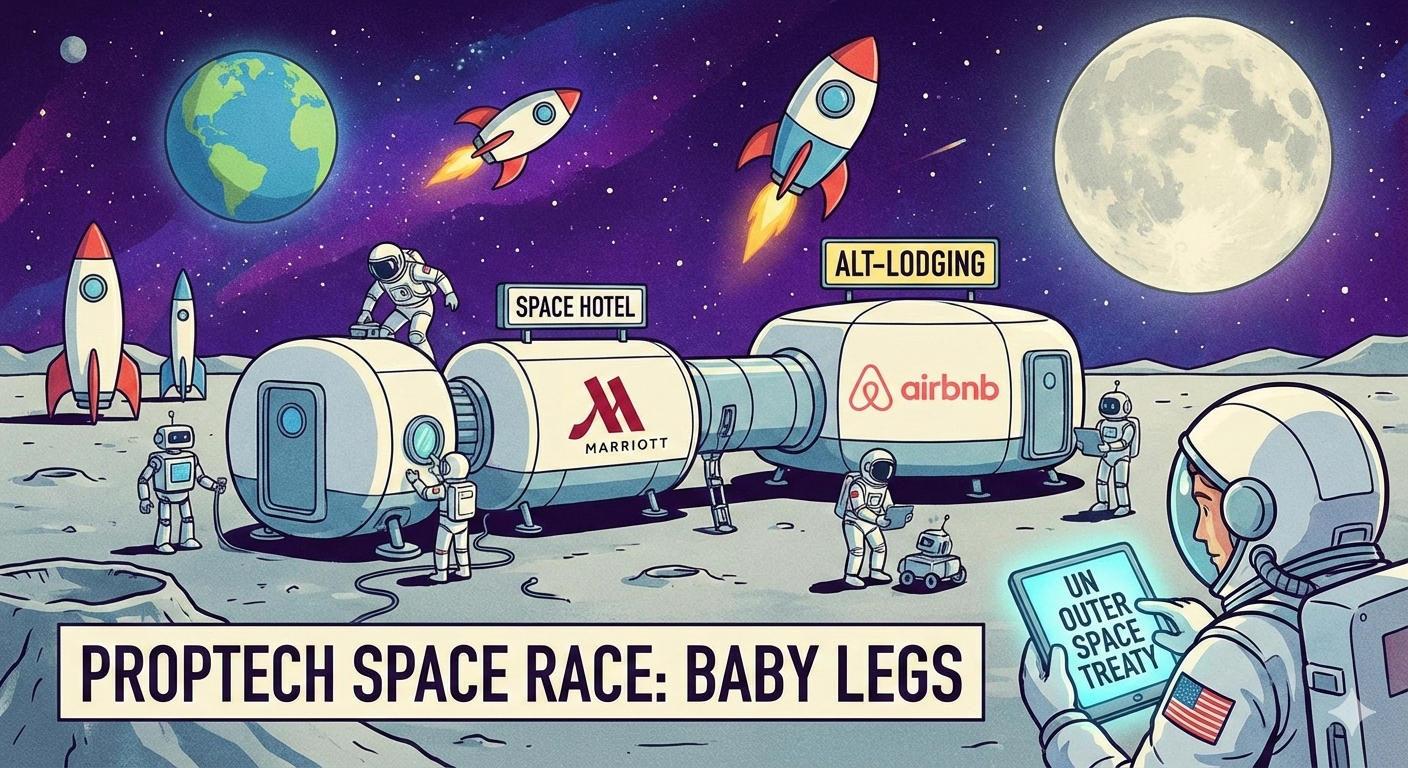
Okay, so I may have gone a bit far here. We’re probably talking decades out, not a 2026 reality. But we have to check whether you’re paying attention. A more realistic near-term outcome would be that the UN decides to re-negotiate the UN-sponsored 1967 Outer Space Treaty.
PREDICTIONS
OPENDOOR ACQUIRES HOMEBOT
Drew Meyers, Founder, Geek Estate
I believe Opendoor will make a home management play—❇️it’s no secret❇️. ❇️Home management❇️ has been a tough vertical to crack, but few things matter more to homeowners than the equity they are building. Homebot delivers that, and would bring a sizable customer base to Opendoor overnight.
MORTGAGE RATES DROP INTO THE 5S
Landy Liu, Founder, Foyer
I foresee global investors continuing searching for stable yield, and in a world of unpredictable equities and softening commercial real estate, mortgage-backed securities will increasingly look appealing. As demand for MBS rises, yields will tighten, and that compression will flow straight through into lower mortgage rates, even without dramatic shifts in the broader economy.
At the same time, affordability pressure is reaching a political and social peak, which creates subtle but meaningful pressure on spreads as policymakers and markets alike attempt to restore balance. With inflation steadily cooling and the Fed signaling an easing bias, the mechanical pathway for lower rates becomes increasingly straightforward rather than speculative.
Put all of these factors together and a drop into the 5s isn’t optimistic—it’s simply where a functioning housing market wants to settle after two years stuck in the 6-7% box.
OPEN: NOT YOUR MAMA’S MEMESTOCK
Heather Harmon, Advisor/Investor
Under new leadership—and with founder DNA in the boardroom—Opendoor will finally prove it is not simply playing roulette on housing volumes by moving into the “always‑on” homeowner relationship. 2026 will bring headwinds, but at the end of the year, OPEN will trade at or above $12.87.
ZILLOW HIRES CHIEF STORYTELLER
Drew Meyers, Founder, Geek Estate
Zillow appointed a Chief Economist (Stan Humphries) long before any of the other portals. Now, every big real estate player has an Economist (Compass being the latest to jump on the bandwagon). Zillow will once again take an early mover advantage—this time by hiring a Chief Storyteller (a trend reported on by the WSJ). As AI bots flood the market with tens of thousands of auto-generated articles, cutting through the noise becomes everything.
And with that, it’s a wrap!
2023 reminded us that fundamentals still matter.
2024 tested our tolerance for chaos.
2025 made AI unavoidable.
2026 will be about judgement. Separating signal from noise. (Which bodes well for GEM, since that’s our jam).
Maybe there’s a swing back to IRL. Maybe not. The AI companies raising millions certainly hope not. The tools that truly work will endure once the noise fades, while the others will collapse under their own hype.
These predictions aren’t about the loudest narratives, but about what’s left standing after the AI madness settles.
Geek Estate's Prior Predictions & Reflections
- 2026 Predictions
- 2025 Predictions // Reflections
- 2024 Predictions // Reflections
- 2023 Predictions // Reflections